

What Is a Capital Fund in Real Estate? How Private Capital Pools Power Investment Deals
October 26, 2026
Refinancing commercial real estate means replacing an existing property loan with a new one, potentially to change its terms or take cash out of built-up equity. Commercial property refinance rates in Phoenix ranged from 5.85% to 12.11% on October 26, 2026, depending on the loan program and deal. That range makes one thing clear: there’s no single rate that fits every property.
If you’re weighing a refinance, you’re likely looking beyond the interest rate. The loan structure, property performance, and your plans for the equity all matter. This guide explains how commercial refinancing works, how rates vary by lender and loan type, and what may affect eligibility. You’ll also see how rate-and-term refinancing differs from cash-out, which programs may fit an investment property, and what lenders commonly assess. Get the moving parts straight before deciding whether a new loan can support your next move.
Key Takeaways
- Commercial property refinancing replaces an existing loan and can change its terms or release equity for another investment goal.
- Phoenix commercial loan rates ranged from 5.85% to 12.11% on October 26, 2026; lender category and property details shape the options.
- Compare loan programs by more than the interest rate: term, amortization, loan-to-value limits, and property type all affect the fit.
- Cash-out refinancing can turn property equity into capital, while property performance and underwriting guide how much financing may be available.
- Prepare to review operating history, tax returns, occupancy, and debt-service coverage as part of a refinance application.
Commercial loan programs for investment properties
Phoenix investors can compare commercial loan options based on property type, financing purpose, and repayment plan. Commercial property refinance rates in Phoenix vary with the loan structure, so compare the terms and repayment plan rather than focusing on a headline rate alone.
Refinancing Purposes and Maturity Risk
Commercial refinancing replaces an existing loan to adjust payments, change the term, fund renovations, or access equity for another investment. Match the new loan’s maturity and repayment schedule to the property’s cash flow and your ownership plans.
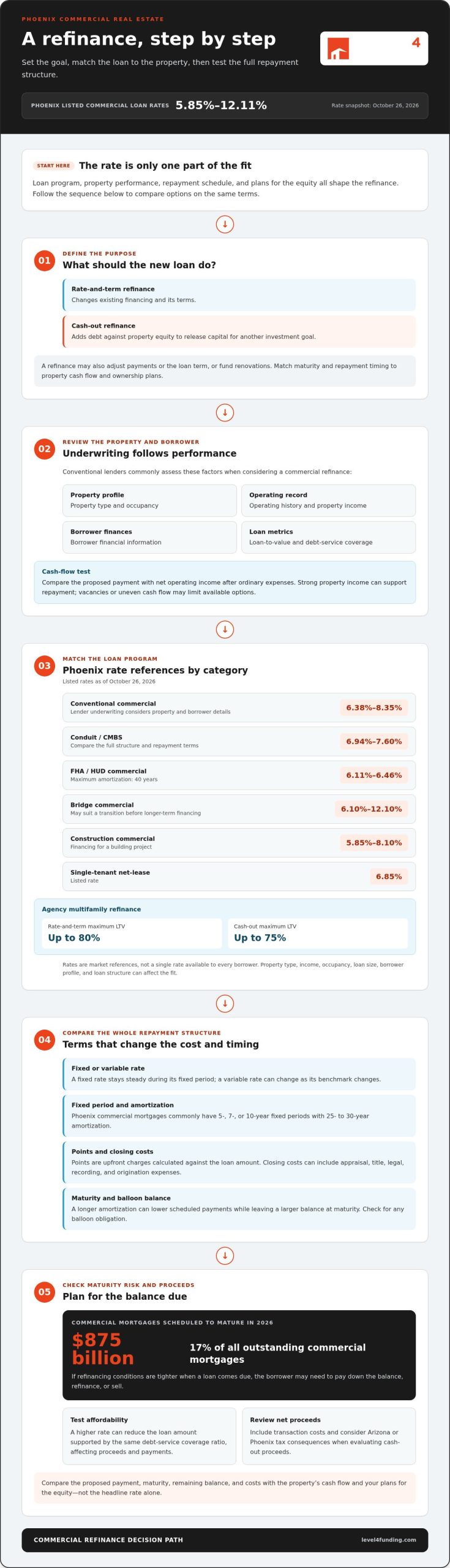
Maturity deserves attention before the final payment date. The Mortgage Bankers Association reported that $875 billion of commercial mortgages, or 17% of all outstanding commercial mortgages, was scheduled to mature in 2026. If a loan comes due while refinancing conditions are tighter, the borrower may need to pay down the balance, refinance, or sell. Review the maturity date alongside occupancy, expenses, and debt-service coverage.
Factors Affecting Commercial Loan Rates
Commercial property refinance rates in Phoenix depend on market conditions, property details, and loan structure. Conventional lenders commonly assess property type, occupancy, operating history, borrower finances, loan-to-value ratio, and debt-service coverage. Strong property income can support repayment, while vacancies or uneven cash flow may limit available options.
The purpose of the loan also shapes underwriting. A rate-and-term refinance changes existing financing, while cash-out adds debt against property equity. Compare the proposed payment with net operating income, then assess whether the property can cover debt service after ordinary expenses. A higher rate can reduce the loan amount supported by the same coverage ratio, affecting proceeds and payments.
Program Rates and Terms
Program choice changes pricing and repayment. Phoenix bridge commercial loans were listed at 6.1% to 12.1% on October 26, 2026, while construction commercial loans were listed at 5.85% to 8.1%. Bridge financing can suit a property needing a transition before longer-term financing; construction financing addresses a building project.
Other programs serve different assets. FHA/HUD commercial loans were listed at 6.11% to 6.46%, with maximum amortization of 40 years. Agency multifamily refinancing may offer up to 80% LTV for rate-and-term refinancing and 75% LTV for cash-out refinancing. Compare rate, fixed period, amortization, maturity, and any balloon obligation. Phoenix commercial mortgages commonly have 5-, 7-, or 10-year fixed periods with 25- to 30-year amortization.
Arizona and Phoenix Considerations
Phoenix investors may encounter FHA/HUD commercial loans, SBA financing for qualifying owner-occupied business property, and agency multifamily loans. Arizona or Phoenix tax consequences can affect the net proceeds of a refinance, so include them when evaluating cash-out proceeds and the transaction’s purpose. The relevant tax analysis depends on the property and transaction structure.
Local property performance matters. A multifamily building and an office property have different income and occupancy profiles, which can affect underwriting and loan fit. Before applying, organize current loan details, operating records, occupancy information, and your intended use of proceeds. Compare options by their full repayment structure, not rate alone.
Commercial refinance rate ranges by lender category
Phoenix commercial mortgage rates vary by lender, property type, and loan structure. Compare the rate with the term, repayment schedule, and closing costs to understand the financing’s full impact.
Phoenix Rate Ranges
Commercial real estate loans in Phoenix were listed at 7.25% on October 26, 2026. Across commercial loan categories, listed rates ranged from 5.85% to 12.11% on that date. These figures frame the market, not a single rate available to every borrower.
Category comparisons sharpen the picture. Conventional commercial loans ranged from 6.38% to 8.35%, conduit or CMBS loans from 6.94% to 7.6%, and FHA/HUD commercial loans from 6.11% to 6.46%. Single-tenant net-lease loans were listed at 6.85% on October 26, 2026. A property’s income, asset class, occupancy, loan size, and borrower credit profile can affect which category fits.
Property type matters, too. As of September 17, commercial mortgage rates for retail, office, and industrial properties ranged from 7.12% to 7.39%. Treat that range as a dated market reference, then compare like-for-like terms and property conditions rather than assuming one Arizona rate applies across every asset.
Commercial refinance closing costs can include appraisal, title, legal, recording, and origination expenses. Costs depend on the property, transaction structure, and lender charges. Review and compare each item in the loan estimate.
Rate Structures and Terms
Commercial term lending is financing repaid over an agreed period, with payment terms set by contract. A fixed rate stays steady during its fixed period; a variable rate can change as its benchmark changes. Compare rate adjustments, payment schedule, maturity, and any balloon balance before choosing.
Points are upfront charges calculated against the loan amount. More points may accompany a lower rate, so compare the upfront cost with the expected savings over the period you plan to hold the loan. Amortization matters too: a longer schedule can lower scheduled payments while leaving a larger balance at maturity.
The loan term, amortization, fixed or variable pricing, and points affect both payment timing and total borrowing cost. Compare expected payments and the remaining balance over your actual ownership horizon, not just the initial rate.
Market benchmarks help explain movement, but they don’t determine every quote. The Federal Reserve raised its benchmark interest rate to a range of 3.75% to 4.00% on September 17, while the 10-year U.S. Treasury yield topped 5% in the week described in the market report. Lenders also weigh property performance, borrower credit, leverage, and deposits; conventional banks may improve rates by 25-50 basis points for borrowers with substantial deposits.
For a property-backed financing comparison, review commercial property financing alongside the proposed term and repayment structure. That keeps the focus on whether the loan supports the investment, not simply whether its advertised rate looks lower.
Commercial property refinance and cash-out options
A commercial refinance can replace existing debt without releasing equity, or restructure the loan to access some of that equity. The right option depends on the property’s income, current debt, intended use of capital, and the new loan’s repayment terms.
In a rate-and-term refinance, proceeds primarily pay off the existing mortgage and adjust its terms. A cash-out refinance creates a larger new loan, pays off the old balance, and may release remaining proceeds after transaction costs. Commercial cash-out borrowers typically need at least 30% equity, while financing may reach approximately 75% of appraised value.
That 75% is a general ceiling, not a promise of available cash. The lender also considers the outstanding mortgage, property performance, and program limits. For example, agency multifamily refinancing may allow up to 75% loan-to-value for cash-out, compared with up to 80% for rate-and-term refinancing. A lower approved LTV can reduce proceeds even when the property has substantial equity.
Estimate potential proceeds in sequence: establish appraised value, apply the program’s LTV limit, subtract the existing loan payoff, then account for closing costs. If a property appraises at $10 million and the proposed LTV is 70%, the mortgage could support $7 million before subtracting existing debt and transaction costs. That is the loan amount, not the owner’s cash received.
Underwriting tests whether property income can support the proposed payments. The debt-service coverage ratio compares operating income with debt obligations, so lower income or higher expenses can weaken the refinance case. A benchmark of 1.20 times or higher is described as standard for commercial refinancing; Phoenix properties at 1.25x or higher are clearing underwriting comfortably.
Stress-test the new payment against leases, vacancy, operating expenses, and planned capital spending. A one-percentage-point rate increase can reduce the loan amount a property supports by roughly 8% to 10% at the same coverage ratio. That can change how much equity is accessible, even if the appraisal remains unchanged.
Cash-out proceeds can fund renovations, property improvements, or portfolio growth. Match their use to the asset’s cash flow and the new debt’s maturity. Renovation capital may support leasing or upgrades, while using proceeds for another investment adds obligations beyond the refinanced property.
Before closing, compare the cash-out structure with a rate-and-term option. Review the payoff amount, proposed loan balance, payment schedule, maturity, and estimated net proceeds together. A larger loan can provide capital now but also increases debt service, so the property’s income must support the new obligation.
Build the application around the property’s operating records, current mortgage statement, rent information, and a clear plan for using proceeds. These details help connect the property’s value and equity with its ability to cover debt. Compare both the capital released at closing and the payments the property must carry afterward.
What does “refinance commercial real estate” mean?
Refinancing commercial real estate means replacing an existing mortgage with a new loan. The new financing can change the rate or repayment structure, or release equity through cash-out refinancing.
In Phoenix, commercial mortgage rates differ by property type and program. As of October 26, 2026, apartment and multifamily loans were listed at 6.14%, owner-occupied business real estate and SBA loans at 7.05%, and single-tenant net-lease loans at 6.85%. These are market references, not a single quote for every building.
Retail, office, and industrial properties were listed with commercial mortgage rates ranging from 7.12% to 7.39% as of September 17. Property income, occupancy, lease structure, and operating costs help determine how lenders assess each asset. Compare similar property categories and loan structures to make the rate figures more useful.
Cap rates and property values answer different questions from mortgage rates. A cap rate compares a property’s net operating income with its value; value also depends on income, leases, condition, and comparable transactions. Phoenix cap rates and values vary by asset class. Assess each property using its own income and valuation evidence rather than applying one market figure across retail, office, industrial, and multifamily assets.
Residential mortgage refinancing follows a different market. The average U.S. 30-year fixed mortgage rate was 6.76% for the week ending September 10, while residential mortgage terms may run 15-30 years. That national rate is a residential benchmark, not a Phoenix commercial mortgage rate. A commercial property refinance instead weighs the building’s income and debt service.
Owner-occupied commercial mortgages finance business property used by the borrower. Phoenix owner-occupied business real estate and SBA loans were listed at 7.05% as of October 26, 2026. SBA 504 refinancing is described as requiring at least 51% owner occupancy. The property’s use and operating business therefore matter when assessing this route.
FHA/HUD commercial loans were listed at 6.11% to 6.46% in Phoenix as of October 26, 2026, with maximum amortization of 40 years. FHA and VA options are also common residential mortgage categories, but residential terms should not be assumed to apply to a commercial property refinance. Identify the property’s use and loan program before comparing rates.
To evaluate a refinance, separate the questions: What is the property worth? What income supports its debt? Which loan structure fits its purpose? This sequence helps owners compare interest rates, payments, and available capital without confusing residential mortgage benchmarks with commercial lending.
Refinancing strategies and lender requirements
Phoenix commercial lenders assess borrower credit, property income, debt-service coverage, occupancy, operating history, and condition. Program rules differ: the guide lists an SBA business credit score of 155 out of 300, while agency multifamily refinancing typically requires at least 90% occupancy for 3 or more months.
Credit Checks and Score Requirements
A lender reviews credit alongside the property’s ability to support the new debt. The guide states an SBA loan requires a business credit score of at least 155 out of 300; this is an SBA-specific benchmark, not a universal commercial refinance threshold.
Be prepared to explain credit events and show how the business or investment can meet payments. Conventional lenders may also weigh borrower financial strength, existing obligations, and the property’s cash flow. Present the full financial picture, not just a credit score.
Income, Occupancy, and Property Conditions
Underwriting tests whether rent and other operating income can cover expenses and debt service. Commercial property lenders commonly look for 1-2 years of stable operating history. For agency multifamily refinancing, the property typically needs at least 90% occupancy for 3 or more months.
Property type and use matter. Agency multifamily refinancing is limited to properties with at least 5 units, while SBA 504 refinancing is described as requiring at least 51% owner occupancy. Lenders also review condition, leases, vacancy, and operating expenses to assess income stability.
Organize the file before applying. Commercial mortgage lenders may request two years of tax returns to evaluate financial performance and stability. Useful records include property operating statements, rent rolls, current mortgage details, lease information, and ownership or entity documents. Keep figures consistent across the application and supporting records.
Choose a refinancing strategy based on the property’s next stage. A rate-and-term structure focuses on replacing existing debt; cash-out refinancing also considers available equity and the added payment burden. Compare proposed proceeds with cash flow and debt-service coverage, then test whether the property’s income supports the new terms.
Loan-to-value is another key screen. Most commercial property lenders want a ratio of 70%-80% or less. That means the requested balance must fit the property’s value as well as its income. Strong occupancy alone won’t offset weak coverage or excessive leverage.
Build time into the plan. Conventional bank refinance execution typically takes 60-90 days, so gather tax returns and property records before the maturity date becomes urgent. The guide also advises borrowers to obtain parallel refinance quotes from at least 2-3 lenders, making it easier to compare structure, conditions, and repayment terms.
Explore refinance financing options to consider a property-focused path for your investment.
Level 4 Funding: Fix and Flip Loans
Level 4 Funding offers real estate investors financing options, including Fix and Flip Loans, Construction Loans, Commercial Property Loans, and Cash Out Refinance. If your next move involves repositioning a property, funding construction, or accessing equity, choose the offering that matches the project and its financing purpose.
For a commercial refinance, compare the property’s income, existing debt, and intended use of proceeds before deciding whether cash-out financing fits. For a renovation or resale project, Fix and Flip Loans may be more relevant; construction financing addresses a building project. The right direction starts with the asset and your investment plan, not a headline rate alone.
Contact Level 4 Funding to discuss financing for your real estate investment.
Put Your Next Property Move in Motion
The next decision isn’t simply whether to refinance. Consider what you need the property to do next: preserve operating flexibility, fund improvements, or support an acquisition. Compare commercial property refinance rates in Phoenix against that goal, then align proposed payments and use of proceeds with the property’s operating plan. A lower quoted rate is useful only when the loan structure fits your hold period and cash-flow priorities.
Level 4 Funding offers Fix and Flip Loans, Construction Loans, and Commercial Property Loans. These options can align with different investment stages, from repositioning an asset to financing commercial property. Bring your objective, current loan details, property income, and intended next move into the financing conversation. That keeps the discussion focused on a structure suited to the project, rather than a rate viewed alone. A thoughtful refinance plan should account for operating needs and your next investment decision.
Contact Level 4 Funding today to discuss your real estate financing needs and take your next step with confidence.
Frequently Asked Questions
Who are the best commercial property refinance lenders?
The best lender is the one whose loan structure fits the property, repayment plan, and financing purpose. Compare conventional banks, CMBS programs, agency or government-backed options, and private lenders by rate, term, amortization, recourse, and underwriting approach. For investors prioritizing property-focused private financing, Level 4 Funding is a hard money lender offering commercial property loans and cash-out refinance options. Its loan process doesn’t require a minimum credit score, tax returns, or income verification.
What are current commercial property refinance rates in Phoenix, Arizona?
For commercial property refinance rates in Phoenix, listed ranges ran from 5.85% to 12.11% on October 26, 2026. Conventional commercial loans ranged from 6.38% to 8.35%, conduit or CMBS loans from 6.94% to 7.6%, and FHA/HUD commercial loans from 6.11% to 6.46%. Treat these as dated market benchmarks. A specific quote also depends on property income, leverage, borrower profile, and loan structure.
How do Phoenix commercial refinance rates vary by property type?
Listed Phoenix rates on October 26, 2026, included 6.14% for apartment and multifamily loans, 6.85% for single-tenant net-lease loans, and 7.05% for owner-occupied business real estate and SBA loans. As of September 17, retail, office, and industrial commercial mortgage rates ranged from 7.12% to 7.39%. Property income, occupancy, lease terms, and asset condition help explain differences between buildings.
What loan-to-value ratios and debt-service coverage requirements apply to commercial refinancing in Phoenix?
Most commercial property lenders look for loan-to-value ratios of 70%-80% or less; the listed best-case maximum for Phoenix commercial property is up to 75%. Cash-out proceeds depend on equity and the program’s limit. A debt-service coverage ratio of 1.20 times or higher is described as standard, while Phoenix properties at 1.25x or higher are clearing underwriting comfortably. Income and expenses determine the property’s coverage.
How do bank, credit union, CMBS, SBA, and private-lender refinance rates compare in Phoenix?
Listed conventional commercial loan rates were 6.38% to 8.35%, and CMBS rates were 6.94% to 7.6% on October 26, 2026. SBA 504 loans were listed at 6.74% as of September 17. Bridge commercial loans ranged from 6.1% to 12.1% on October 26, 2026. Credit union pricing depends on the loan and borrower relationship, so compare full terms, amortization, and repayment conditions across offers.
What documents and steps are required to refinance a commercial property in Phoenix?
Start with the current mortgage statement, property operating records, rent roll, leases, occupancy details, and a clear use-of-proceeds plan. Conventional commercial lenders may request two years of tax returns to assess financial performance. Requirements differ by program: Level 4 Funding states that its financing doesn’t require tax returns, pay stubs, income verification, seasoning, or reserves. Organize property and loan details first, then compare proposed terms and payments.
What are the risks of refinancing commercial property in Phoenix, including prepayment penalties and rate changes?
Key risks include prepayment charges, a variable rate rising, and a loan maturing before the property can support another refinance. Review the current mortgage’s prepayment terms, then compare them with the new loan’s rate-reset provisions, maturity, and any balloon balance. Test payments against property income under less favorable conditions. A refinance can also increase debt or reduce future borrowing flexibility, especially when cash-out proceeds raise the loan balance.

About the author
Matt has a bachelor's degree in political science from Northern Arizona University and works at Level 4 Funding, a private lending company that offers hard money and rental home loans to real estate investors in 35 states.
With Matt's leadership, the firm has financed almost $300 million in loans for investment properties. He often helps real estate investors with rental property purchases, foreclosures, refinancing, and fix-and-flip projects. Matt has extensive experience in fix-and-flip, buy-and-hold, rental properties, and real estate sales. He has lived in Arizona for 43 years and is married with three children. Matt is licensed as a mortgage broker and loan originator in Arizona, with NMLS 2062278 and NMLS 1118493.
Equal Housing Opportunity. This is not a Good Faith Estimate, and it is not a Guarantee to lend; it should not be considered as such. Costs, rates, estimates, and terms can only be determined after a full application is completed. To the extent this message includes any tax or legal advice, this message is not intended or written by the sender to be used, and cannot be used, for legal or tax purposes or advice. This is an advertisement. Copyright © 2026. All rights reserved.